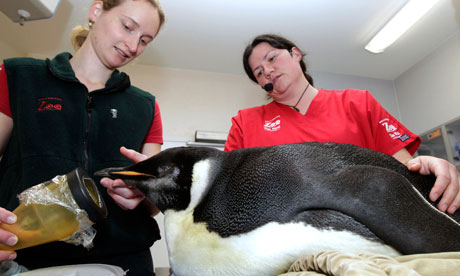
WILDLIFE — WELLINGTON, NEW ZEALAND) After attracting
tons of media attention due to the rarity of his arrival and
scaring animal lovers everywhere with his fast spiral into ill
health, New Zealand’s visiting penguin Happy Feet is recovering
from surgery.
While all are happy to see the stoic bird healing well, many
are confused at the curious lack of information on the penguin.
Even after an operation and much care, scientists are not yet able
to identify the age or even sex of the penguin. In the meantime,
all hope for a quick and painless recovery and return home for the
wayward bird. — Global Animal

New Zealand’s favourite penguin
visitor is more lively and eating fish after undergoing endoscopic
surgery to remove some of the sand and twigs it apparently mistook
for snow and swallowed.
Full recovery for the young emperor
penguin – nicknamed Happy Feet – may take months. Officials are
unsure when or how it could return home to the Antarctic, about
2,000 miles away.
The bird was recovering well after
the endoscopy, performed on Monday by one of New Zealand’s leading
surgeons – for human patients.
Doctors at the Wellington zoo
guided a camera on a tube through the penguin’s swollen intestines
and flushed its stomach to remove the swallowed sand and pieces of
driftwood. Penguins eat snow to hydrate themselves during the
Antarctic winter.
To ensure the health of its newest
star, the zoo brought in Wellington hospital specialist John Wyeth
to help with the procedure, the Press Association reported.
The surgery went well, and doctors
removed about half of the remaining sand and several twigs from the
bird’s digestive system, a zoo spokeswoman, Kate Baker, said.
Medical staff hope the rest of the debris will pass naturally, but
an x-ray is scheduled for Wednesday.
“It’s positive news, but he’s
definitely not out of the woods yet,” Baker said.
The penguin is now dining on fish
slurry and has been standing and appearing more active than when it
arrived, she added.
The bird was moved to the
zoo on Friday after its health worsened on the beach.
The penguin is being housed in a
room at the zoo chilled to about 46F (8C), Baker said, and has a
bed of ice on which it can sleep.
Happy Feet, nicknamed from the 2006
animated film, was discovered last week on a North Island
beach, the first spotting of an emperor in New Zealand in 44 years.
Emperors typically spend their entire lives aroundAntarctica.
After landing on Peka Peka beach,
the penguin appeared healthy at first, but it became dehydrated,
suffered heat exhaustion and was eating large amounts of sand.
Peter Simpson, the programme
manager of diversity for the department of conservation, said he
would meet with penguin experts at the zoo on Wednesday to consider
Happy Feet’s next steps. He said it was not simply a matter of
tossing the penguin back into the ocean off New Zealand’s
coast.
“There’s no great rush to decide,”
Simpson said. “It will most likely need more medical work over the
next three months.”
Simpson said the penguin was likely
to remain at the zoo for that time while it recovered.
Gareth Morgan, a New Zealand
investment adviser, has offered to transport the penguin back to
Antarctica next February when he leads an expedition to there. But
Simpson said that, while officials appreciate the offer, they may
want to act before then.
Simpson said the penguin may be
older than experts first thought – perhaps up to two-and-a-half
years old rather than the initial estimate of 10 months. It stands
about 80cm (3ft) high.
Experts still do not know if it is
a male or female, Simpson said, although DNA samples should soon
provide an answer.